A registry platform can appear stable right up to the moment a peak registration event, a failed integration, or a policy change exposes a design decision made years earlier. This domain registry architecture guide focuses on the components that determine whether a ccTLD, gTLD, branded namespace, or private registry can operate reliably, adapt quickly, and grow without placing registrants or channel partners at risk.
For registry operators, architecture is not an abstract technology exercise. It shapes the quality of registrar service, the speed of launches, the accuracy of reporting, the recoverability of critical data, and the operator’s ability to meet contractual and regulatory obligations. The right design connects these concerns without turning every policy update or product change into a high-risk engineering project.
What a Registry Architecture Must Support
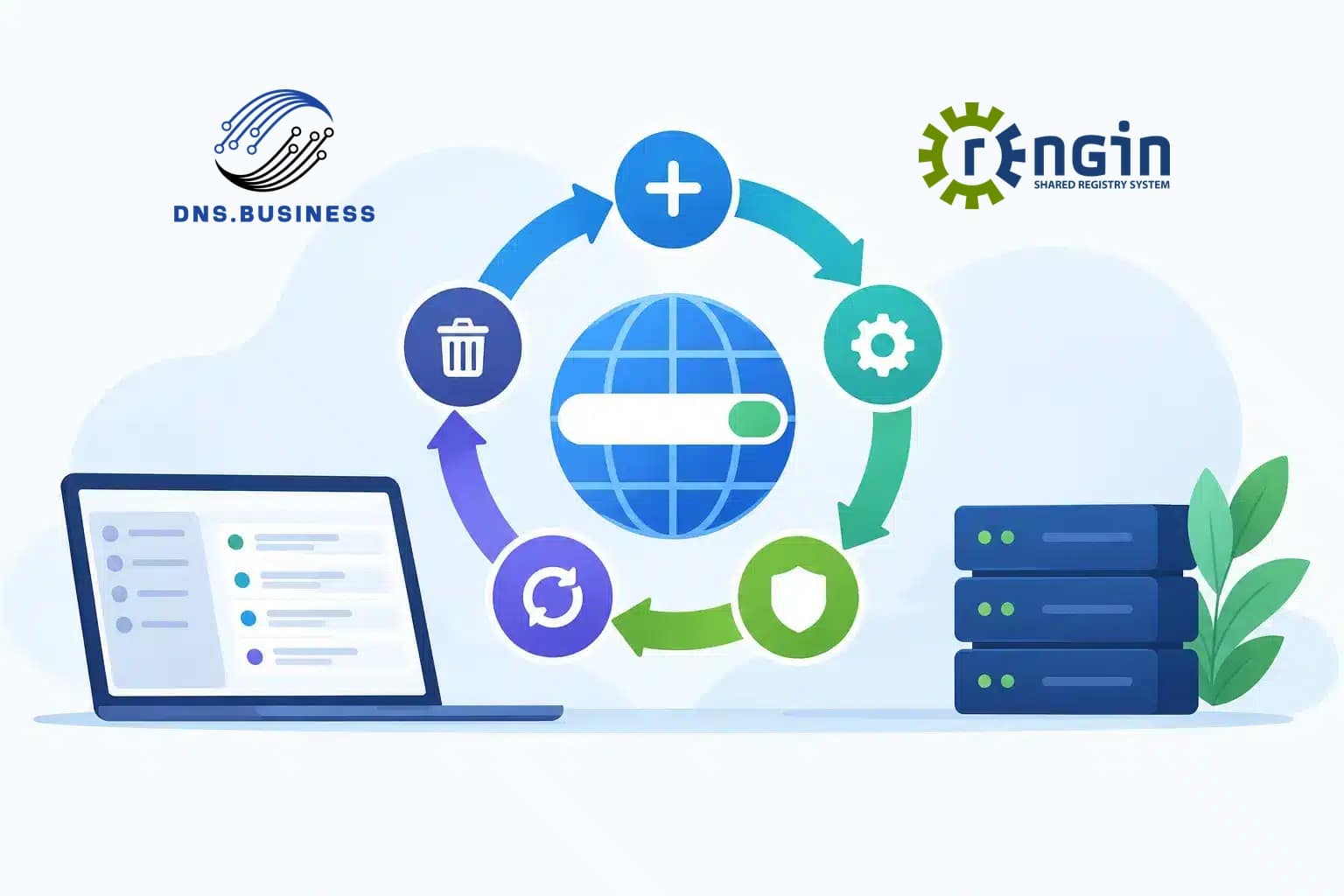
A domain registry is a system of record, a transaction platform, and an industry integration point. It must process creates, renewals, transfers, updates, deletes, restores, and contacts with consistent business rules. It must also publish delegated names to the DNS, provide authorized registrar access, preserve an auditable history, and expose accurate information to registrants, policymakers, and authorized parties.
Those functions have different performance profiles. EPP transactions require strict validation and predictable responses. DNS publication requires fast, controlled propagation. Reporting may involve large data sets and scheduled workloads. Compliance functions often require retention, traceability, and carefully managed access. Treating every function as part of one tightly coupled application increases the blast radius of ordinary operational changes.
A practical architecture separates responsibilities while maintaining a single authoritative registry data model. The registry database should remain the source of truth for object state and lifecycle events. Surrounding services can then handle interfaces, provisioning, DNS generation, reporting, notifications, billing, and analytics without compromising transaction integrity.
The Core Layers of a Domain Registry Architecture Guide
The most effective registry environments are layered. The exact technology stack varies by registry size, policy model, and contractual requirements, but the operating model should make ownership, failure boundaries, and data flow clear.
Authoritative Registry Data and Lifecycle Logic
At the center sits the authoritative data layer for domains, hosts, contacts, registrars, statuses, fees, and lifecycle events. This layer must enforce registry policy consistently, including eligibility checks, reserved-name rules, grace periods, redemption policies, transfer restrictions, and premium name controls.
Data design matters as much as application logic. Every state-changing transaction should be atomic, timestamped, attributable, and recoverable. Operators need an immutable audit trail that answers practical questions: who submitted a command, under which credentials, what policy rule was applied, what changed, and when was the change published to dependent systems?
High availability does not mean accepting inconsistent data. A registry should prioritize correctness for authoritative transactions, then use controlled replication and event processing for downstream functions. This trade-off is essential. A delayed analytics dashboard is inconvenient; an incorrectly registered or deleted domain is an operational and reputational incident.
Registrar Access and Provisioning Services
EPP remains the primary provisioning protocol for much of the domain industry, but a registry’s interface strategy should extend beyond protocol availability. Registrars need predictable command behavior, clear error responses, rate controls, test environments, documentation, credential management, and operational visibility.
A well-designed EPP layer validates syntax, authenticates the registrar, applies authorization and policy rules, submits valid changes to the authoritative transaction engine, and returns a reliable result. It should not become a place where undocumented exceptions or registrar-specific logic accumulate. Those shortcuts are difficult to test and can make later migrations significantly more complex.
For some channels, a secured API or management portal can complement EPP. This can be useful for reporting, finance, support workflows, or limited operational tasks. The decision depends on the channel model. Large accredited registrars generally require standards-based automation, while a managed reseller network may benefit from purpose-built interfaces and delegated administration.
DNS Publication and Zone Management
Registration is only one half of the operator’s responsibility. A domain must also resolve correctly after delegation. The registry architecture should therefore include an explicit, monitored path from accepted domain state to zone generation and authoritative DNS publication.
This path should validate nameserver objects and glue data, generate zone changes from approved registry events, distribute zones securely to authoritative DNS infrastructure, and confirm publication health. Operators should be able to distinguish between a successful registration transaction and confirmed DNS availability. Combining the two statuses in operational reporting prevents support teams from diagnosing DNS incidents through guesswork.
The DNS layer needs geographic resilience, capacity headroom, DDoS protections, and disciplined change control. However, it should not directly alter authoritative registry records. DNS infrastructure publishes delegation data derived from the registry. Keeping that boundary intact prevents operational interventions from creating conflicting sources of truth.
Integration, Events, and Operational Automation
Registries connect to more than registrars and DNS. They often integrate with payment systems, escrow providers, identity or eligibility services, abuse handling tools, data warehouses, notification platforms, and policy reporting processes. Point-to-point integrations can work at small scale, but they become fragile when each new service requires direct access to core registry tables.
An event-driven integration layer provides a better control point. When a domain is created, renewed, transferred, or deleted, the core platform can publish a governed event for authorized downstream services. Consumers can process notifications, billing updates, zone publication, analytics, and compliance tasks independently, with retry controls and traceable delivery.
This does not mean every registry requires a complex microservices estate. Smaller registries may achieve better reliability with a modular platform and a limited number of well-defined integrations. The principle is to avoid coupling noncritical work to the transaction path. If a reporting service slows down, registrar provisioning should continue.
Security and Compliance Must Be Built Into the Operating Model
Registry security is not limited to firewalls and encrypted connections. It requires controls across identity, access, data, operations, and recovery. Privileged access should be role-based, time-limited where possible, and fully logged. Production changes should require accountable approvals, and credentials for registrars, staff, and automated services should be rotated under a defined policy.
Sensitive data requires classification and retention rules. Depending on the registry’s jurisdiction and policy obligations, this may include registrant data, contact information, financial records, audit logs, and registrar account records. Encryption in transit and at rest is expected, but operators also need to control who can decrypt, export, or aggregate that data.
Compliance architecture must support evidence, not just intent. Operators should be able to demonstrate backup completion, access reviews, patch management, incident handling, service availability, and change records. ISO-aligned processes and ICANN-related obligations are easier to maintain when the platform creates usable operational evidence as part of normal work.
Design for Failure, Recovery, and Migration
Every registry should assume that components will fail. The architectural question is whether the failure is isolated, detected quickly, and recoverable within documented objectives. Define recovery point objectives and recovery time objectives for the authoritative registry database, EPP service, DNS publication pipeline, reporting environment, and supporting systems separately. One number for the entire platform conceals important risk.
Backups must be tested through restoration, not merely monitored for completion. Disaster recovery environments must be capable of handling real transaction volumes and operational procedures, including secure access, registrar communications, data reconciliation, and DNS continuity. A recovery plan that only restores databases is incomplete.
Migration deserves the same architectural discipline. Legacy registry replacement involves data conversion, policy mapping, registrar onboarding, reconciliation, parallel testing, cutover controls, and post-launch support. The greatest migration risks often sit at the edges: unsupported status values, historical billing exceptions, inconsistent contact records, registrar-specific behavior, or undocumented manual processes.
DNS.Business approaches registry modernization as an operational transition, not simply a software deployment. That distinction matters when millions of domains, active registrar channels, and contractual service commitments are involved.
Capacity Planning Is About Behavior, Not Domain Count
A registry with 100,000 names can require more transaction capacity than one with one million names if it experiences high-volume launches, promotions, drops, or automated registrar activity. Capacity planning should model command rates, concurrent sessions, database writes, zone update volume, reporting workloads, and anticipated denial-of-service conditions.
Measure baseline performance, then test realistic stress cases. Include registrar retry storms, bulk renewals, availability checks, launch-day registrations, DNS update bursts, and delayed downstream consumers. Rate limiting and quotas should protect shared infrastructure without unfairly restricting legitimate registrar operations.
Scalability also has an organizational dimension. A platform can scale technically while still depending on a small group of people who understand its exceptions. Standardized runbooks, monitored service-level indicators, controlled deployments, and clear escalation paths turn capacity into sustainable operational capability.
Choosing the Right Architectural Model
There is no single correct registry architecture. A new gTLD entering a controlled launch may prioritize launch phases, eligibility validation, premium pricing, and registrar certification. A national ccTLD may place greater emphasis on local policy, government reporting, multilingual support, and long-term data sovereignty. An enterprise namespace may require close integration with corporate identity systems and internal governance.
The decision should begin with policy and operating requirements, then move to technology. Ask which functions must remain authoritative, which services require real-time behavior, which data can be processed asynchronously, and which obligations must be evidenced during an audit or incident. These answers create a clearer architecture than selecting tools first.
The strongest registry designs make routine work predictable and exceptional events manageable. Build clear boundaries around authoritative data, protect the transaction path, test recovery under realistic conditions, and retain the flexibility to evolve policy and services. That is how a registry platform supports not only the next registration, but the next decade of growth.